




Durme, mi linda donzeya
Alternative Title: Durme, durme, Ermoza donzeya, La ermoza durmiente, La bella durmiente, La ermoza dunzelia
Description
This is a Sephardic love song, one of the most tender texts in the tradition, expressing the noble desire of a young man for the girl of his heart. The melody and lyrics convey emotion and devotion, and from the words of the song, one can infer that it was likely sung as a serenade beneath a young woman’s window. The composition opens with the characteristic phrase "durme, durme" (sleep, sleep), which is common in many Sephardic lullabies and signals the tenderness and intimacy of the song. The lyrics then develop into a love confession, addressed to the beautiful young woman who is asleep, which is why it often carries the alternative title "La ermoza durmiente" (The sleeping beauty) This song is among the most popular pieces in the Sephardic music tradition and is documented in numerous sources. It is found in various regions, including Rhodes and Thessaloniki in Greece, as well as in areas of Turkey such as Silivri (or Silivbria), Çanakkale (Dardanelles), and Istanbul. Both oral and written records show a wide variety of variations in the lyrics and the melody. On this platform, we present only some of the most interesting versions, recorded as originating from Greece.
Version 1
Durme, mi linda donzeya
Flora Molcho Archive.
Performed by her parents, Isaac and Rita Molcho. This recording appears incomplete, as the first verse is missing. Nevertheless, it presents exceptional interest in the lyrics.
Alternative Title: Durme, durme, Ermoza donzeya, La ermoza durmiente, La bella durmiente, La ermoza dunzelia
Lyrics
Syente djoya al son de mi kitara /ˈsjente ˈdʒoja al son de mi kiˈtaɾa/ Listen to the joy in the sound of my guitar
syente ermoza, mis malles kanta /ˈsjente eɾˈmoza mis ˈmaʝes ˈkanta/ Listen, beautiful, as it sings my pains
Ay dos anyos ke sufre mi alma /aɪ dos ˈaɲos ke ˈsufɾe mi ˈalma/ For two years my soul has suffered
por ti kerida, mi linda d’amar /poɾ ti keˈɾiða mi ˈlinda ðaˈmaɾ/ For you, my beloved, my sweet love
Yo non durmo ni noche, ni dia /jo non ˈduɾmo ni ˈnotʃe ni ˈdia/ I don’t sleep, neither night nor day
los ke aman angustian los ghian /los ke ˈaman aŋɣusˈtjan los ˈɣjan/ Those who love cause envy
Durme, durme mi linda donzeya /ˈduɾme ˈduɾme mi ˈlinda donˈzeja/ Sleep, sleep, my beautiful girl
durme, durme sin ansia i pasyon /ˈduɾme ˈduɾme sin ˈansja i paˈsjon/ Sleep, sleep without anxiety and passion
Este sklavo ke tanto dezea /ˈeste ˈsklaβo ke ˈtanto deˈzea/ This slave here, who longs so much
ver tu suenyo, sin ansia i dolor /veɾ tu ˈsweɲo sin ˈansja i doˈloɾ/ To see your dream, without anxiety or pain
Version 2
Durme, mi linda donzeya
Flora Molcho Archive Unknown performer
Alternative Title: Durme, durme, Ermoza donzeya, La ermoza durmiente, La bella durmiente, La ermoza dunzelia
Lyrics
Durme, durme mi linda donzeya, /ˈduɾme ˈduɾme mi ˈlinda donˈzeja/ Sleep, sleep, my beautiful girl
durme, durme sin ansia i pasyon. /ˈduɾme ˈduɾme sin ˈansja i paˈsjon/ Sleep, sleep without anxiety and passion
Ay dos anyos ke sufre mi alma /aɪ dos ˈaɲos ke ˈsufɾe mi ˈalma/ It’s been two years that my souls has been suffering
por ti kriza mi linda dama /poɾ ti ˈkɾiza mi ˈlinda ˈdama/ for you I am suffering my sweet lady.
Version 3
Durme, mi linda donzeya
Maale Adumim Institute, Catalogue number: 1858 http://folkmasa.org/avshir/shirp.php?mishtane=1858.
Performed by Renee Bivas. It’s a short version of the song with lots of melismata.
Alternative Title: Durme, durme, Ermoza donzeya, La ermoza durmiente, La bella durmiente, La ermoza dunzelia
Lyrics
Durme, durme ermoza donzea /ˈduɾme ˈduɾme mi ˈlinda donˈzea/ Sleep, oh sleep sweet girl
Durme durme sin ansia i dolor /ˈduɾme ˈduɾme sin ˈansja i doˈloɾ/ Sleep without anguish and pain.
Yo non durmo ni noche ni dia /jo non ˈduɾmo ni ˈnotʃe ni ˈdia/ I don’t sleep night or day.
Por ti ermoza kerida mia /poɾ ti eɾˈmoza keˈɾiða ˈmia/ because of you my beloved.
Version 4
Durme, mi linda donzeya
Database of Maale Adumim Institute, catalogue number: 1383 http://folkmasa.org/avshir/shirp.php?mishtane=1383.
Performed by Amelie Pinhas. Undoubtedly, this recording stands out as the most interesting, both for its strong lyrical content and for a unique addition to the melody of the song toward the end, which gives it a distinctive character.
Alternative Title: Durme, durme, Ermoza donzeya, La ermoza durmiente, La bella durmiente, La ermoza dunzelia
Lyrics
Durme, durme ermoza donzeya /ˈduɾme ˈduɾme eɾˈmoza donˈzea/ Sleep, sleep, beautiful young lady
Durme, durme sin ansia i dolor /ˈduɾme ˈduɾme sin ˈansja i doˈloɾ/ Sleep, sleep, without anxiety and pain
Ser tu 'sklavo ke tanto dezeya /seɾ tu ˈsklavo ke ˈtanto deˈzea/ To be your slave who longs so much
Ver tu s[f]uenyo kon grande amor /veɾ tu ˈsweɲo kon ˈɡɾande aˈmoɾ/ To see your dream with great love
Ay dos anyos ke sufre mi vid /aɪ dos ˈaɲos ke ˈsufɾe mi ˈviða/ For two years my life has suffered
Sufre, sufre por ti, me kerida /ˈsufɾe ˈsufɾe poɾ ti me keˈɾiða/ Suffers, suffers for you, my beloved
El dia vo yorando la noche sen dormir /el ˈdi.a bo joˈɾando la ˈnotʃe sen duɾˈmiɾ/ During the day I cry and at night I don’t sleep
Pensando i sospirando fin a kuando va sufrir /penˈsando i sospiˈɾando fin a ˈkwando va suˈfɾiɾ/ Thinking and sighing until when I will suffer
El dia vo yorando i la noche, sen dormir /el ˈdi.a bo joˈɾando i la ˈnotʃe sen duɾˈmiɾ/ During the day I cry and at night I don’t sleep
Pensando en ti, kerida, komo me vo despartir /penˈsando en ti keˈɾiða ˈkomo me vo desparˈtiɾ/ Thinking of you, my beloved, how will I leave you
Version 5
Durme, mi linda donzeya
Database of Maale Adumim Institute, Catalogue number: 1395 http://folkmasa.org/avshir/shirp.php?mishtane=1395.
Performed by Ester Akoen.
This particular recording features a distinctive characteristic often encountered in folk songs. The singer, named Ester Akoen, personifies the lyrics, making reference to her family. The entire final line appears to be her own addition or, possibly, an addition from a member of her family, as it does not appear in any other recording of this song, nor even in any variation of it.
Alternative Title: Durme, durme, Ermoza donzeya, La ermoza durmiente, La bella durmiente, La ermoza dunzelia
Lyrics
This particular recording features a distinctive characteristic often encountered in folk songs. The singer, named Ester Akoen, personifies the lyrics, making reference to her family. The entire final line appears to be her own addition or, possibly, an addition from a member of her family, as it does not appear in any other recording of this song, nor even in any variation of it.
Durme durme ermoza donzeya /ˈduɾme ˈduɾme eɾˈmoza donˈzeja/ Sleep, sleep, beautiful girl
Durme durme sin ansia i dolor /ˈduɾme ˈduɾme sin ˈansja i doˈloɾ/ Sleep, sleep, without anxiety and pain
Ay anyo i medio ke sufre mi alma /aɪ ˈaɲo i ˈmeðio ke ˈsufɾe mi ˈalma/ For a year and a half my soul has suffered
Por ti kerida, ija linda de mi korason /poɾ ti keˈɾiða ˈiʒa ˈlinda de mi koɾaˈson/ For you, beloved, beautiful daughter of my heart
No solo tu madre, sino ke toda la famiya /no ˈsolo tu ˈmaðɾe ˈsino ke ˈtoða la faˈmija/ Not only your mother, but the whole family
la famiya de Akoen... /la faˈmija de aˈkoen/ The family of Akoen…
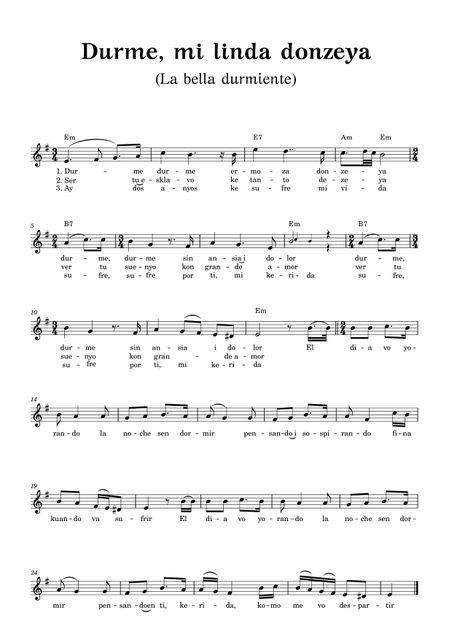
Note: The lead sheet is based on the generic melody of this very popular song. At the end, the melodic addition as sung by Amelie Pinhas is included.
Music Guide

 Bibliography
El Trezoro de Kantes de Sefarad. El Instituto Maale Adumim para la documentación de la lengua judeo-española y su cultura, folkmasa.org. Nehama, Joseph. Dictionnaire du Judéo-Espagnol. Consejo superior de investigaciones cientificas. Madrid, 1977. Research, analysis, translations and IPA transcriptions: Mariangela Chatzistamatiou Aural transcriptions and lead sheets: Nikos Panagiotides
Disclaimer: The content on this website is protected by copyright. Use of the content is allowed for personal or educational purposes only with clear citation of the source. Republishing, modifying, or using the content for commercial purposes is prohibited without prior explicit permission.

