






La galana i el mar
Description
Wedding song, one of the most popular in the Greek and wider Sephardic tradition. According to the scholar Alberto Hemsi, it is found in both Thessaloniki and Rhodes and dates back to the Spanish period[1]. Rabbi Michael Molho mentions that it is one of the songs that women sang to the bride before the wedding and during the "mikveh" i.e. the ritual bath. The custom is established in Israeli communities everywhere before the wedding or every month and sometimes on special occasions. The mikveh is performed in a special bath-hamam. After the bride enters the bath, the women sing to her. In this particular song we see fertility wishes being given in the form of metaphors making references to fruit trees and their fruits.[2] If a city did not have or does not have a mikveh, the process of symbolic consecration takes place in the sea and perhaps this song refers to this situation, at least symbolically. It is one of the most popular and much-recorded songs in the repertoire. Here we present some rare sound recordings from the archives of Flora Molho and the Maale Adumim Institute.
Music guide lyrics The lyrics in question are a combination from all sources. It is up to the discretion of the individual performer which lyrics to perform.
Folkmamasa https://folkmasa.org/avshir/shirp.php?mishtane=684
Commercial discography https://open.spotify.com/track/5y7AT4NrLNFosVSeEa6uST?si=deb28a5e4c85401b
Version 1
La galana i el mar
Lyrics
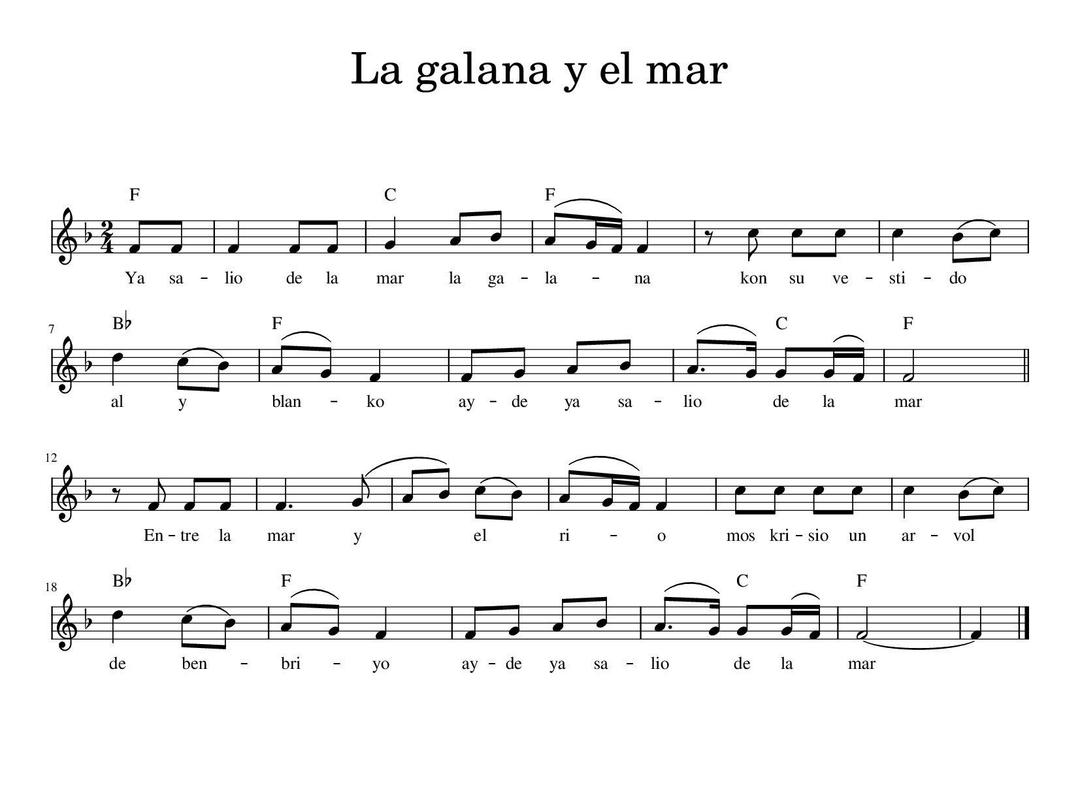
Ya salio de la mar la galana kon un vestido al y blanko. Ayde[3], eya salio de la mar Entre la mar y el rio mos kresyo un arbol de benbriyo. Ayde, eya salio de la mar. Entre la mar y l’ arena mos kresyo un arbol de kanela.[4] Ayde, eya salio de la mar. La novia se v air al banyo, el novyo ya la esta asperando. Ayde, se va ir al mar.
Translation
Out of the sea came the beautiful In a blue and white dress. Aide, she came out of the sea. Between the sea and the river A bell grew for us. Aide, she came out of the sea. Between the sea and the sand A cinnamon tree grew for us. Aide, it came out of the sea. The bride will go to the bath, the groom is already waiting for her. Aide, she's going to the sea.
Version 2
La galana i el mar
Lyrics
Ya salio de la mar la galana kon un vestido al y blanko. Ayde[3], eya salio de la mar Entre la mar y el rio mos kresyo un arbol de benbriyo. Ayde, eya salio de la mar. Entre la mar y l’ arena mos kresyo un arbol de kanela.[4] Ayde, eya salio de la mar. La novia se v air al banyo, el novyo ya la esta asperando. Ayde, se va ir al mar.
Translation
Out of the sea came the beautiful In a blue and white dress. Aide, she came out of the sea. Between the sea and the river A bell grew for us. Aide, she came out of the sea. Between the sea and the sand A cinnamon tree grew for us. Aide, it came out of the sea. The bride will go to the bath, the groom is already waiting for her. Aide, she's going to the sea.
Version 3
La galana i el mar
Lyrics
Ya salio de la mar la galana kon un vestido al y blanko. Ayde[3], eya salio de la mar Entre la mar y el rio mos kresyo un arbol de benbriyo. Ayde, eya salio de la mar. Entre la mar y l’ arena mos kresyo un arbol de kanela.[4] Ayde, eya salio de la mar. La novia se v air al banyo, el novyo ya la esta asperando. Ayde, se va ir al mar.
Translation
Out of the sea came the beautiful In a blue and white dress. Aide, she came out of the sea. Between the sea and the river A bell grew for us. Aide, she came out of the sea. Between the sea and the sand A cinnamon tree grew for us. Aide, it came out of the sea. The bride will go to the bath, the groom is already waiting for her. Aide, she's going to the sea.
Music Guide

 Bibliography
El Trezoro de Kantes de Sefarad. El Instituto Maale Adumim para la documentación de la lengua judeo-española y su cultura, folkmasa.org.
Hemsi, Alberto, and Samuel G. Armistead. Cancionero Sefardi. Edited by Edwin Seroussi. Vol. 4. Jerusalem: Jewish Music Research Centre, The Hebrew University of Jerusalem, 1995.
Molho, Michael. Traditions and Customs of the Sephardic Jews of Salonica. Edited by
Robert Bedford. Translated by Alfred A. Zara. 1944. Reprint, New York:
Foundation for the Advancement of Sephardic Studies and Culture, 2006.
Weich-Shahak, Susana. “The Songs and Their Music.” Ventanas Altas de Saloniki. University of Haifa, 2013.

