







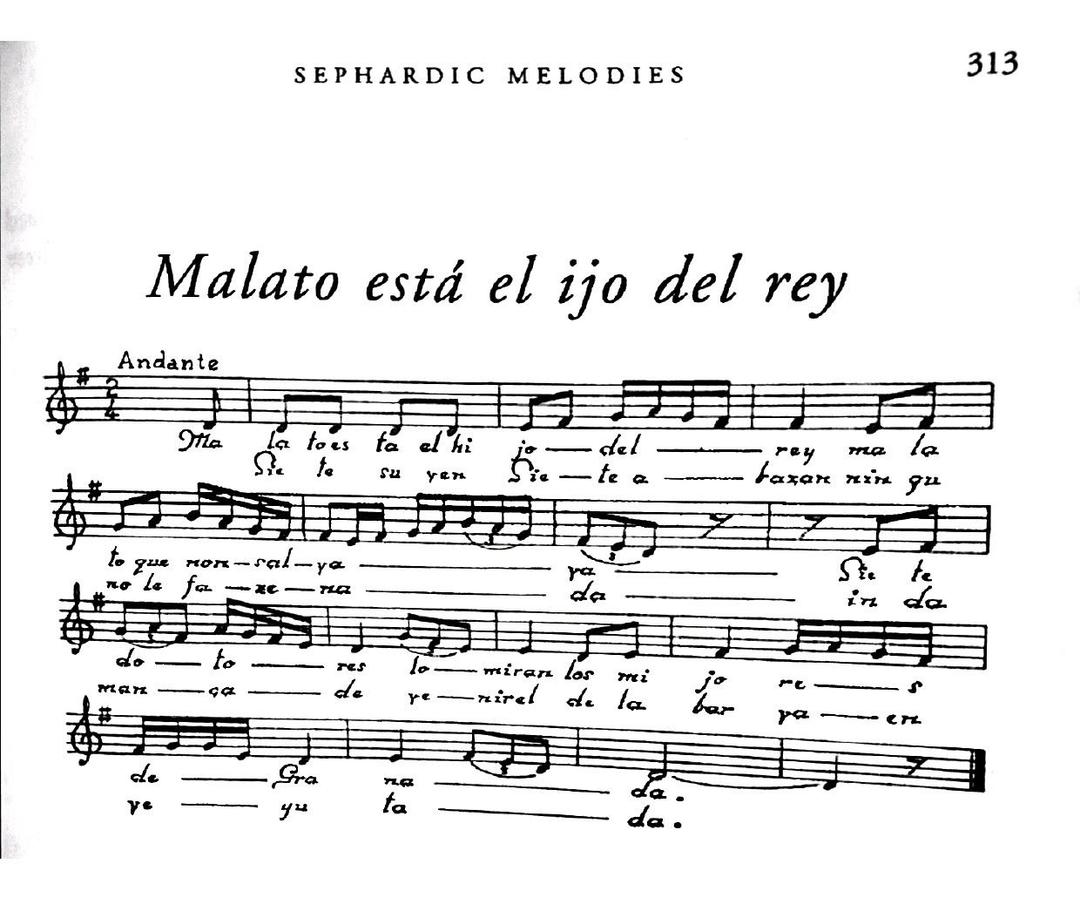
Malato esta el fijo del Rey
Version from Flora Molho Archive
Alternative Title: "The Death of Prince Don Juan"
Description
This is a mourning song, which Rabbi Michael Molcho categorizes as part of the Tisha B'Av observance. Tisha B'Av, the 9th day of the Hebrew month of Av (which falls either at the end of July or the beginning of August), is the saddest day in the Jewish calendar. On this day, fasting, abstinence, and prayer are observed. It marks several tragic events in Jewish history, including the destruction of both Temples of Solomon.
In Ladino (Judeo-Spanish), the songs of Tisha B'Av are called endechas, meaning "lamentations," and are classified as romances. Romances are long narrative poems, typically inspired by medieval Spain, telling stories of knights, princes, and kings.
This particular song is a multi-stanza, narrative piece with sorrowful content. It doesn't directly reflect the themes of Tisha B'Av, but instead tells a narrative ballad, in which the king’s son is gravely ill, with no hope for a cure. The reference to Granada, in southern Spain, suggests that this is an old song from the Sephardic tradition.
The poem has eleven stanzas, each consisting of four lines. The odd-numbered lines stand alone, while the even-numbered lines rhyme with each other.
The only known melody for this song was preserved by Rabbi Michael Molcho of Thessaloniki in his book Traditions and Customs of the Sephardic Jews of Salonica.
Ethnomusicologist Alberto Hemsi (June 27, 1898 – October 8, 1975) also recorded this song, but with the different title "La muerte del príncipe don Juan." The lyrics in his version differ slightly, but the overall story remains the same. It is common in Sephardic music for the same song to appear with different titles and with slight variations in lyrics over time and across regions.
Note on the score: The available musical guide has been adapted for performance by modern musicians.
Version from Flora Molho Archive
Malato esta el fijo del Rey
Version from Flora Molho Archive
Alternative Title: "The Death of Prince Don Juan"
Lyrics
1.
Malato esta el fijo del rey, /maˈla.to esˈta el ˈfi. ʒo del ˈreɪ/ The king’s son lies ill,
Malato ke no salvava, /maˈla.to ke no salˈva.va/ sick without hope of a cure.
Syete dotores lo miran, /ˈsje.te doˈto.res lo ˈmi.ran/ Seven doctors care for him,
Los mijores de Granada. /los miˈ ʒo.res de γraˈna.da/ the finest in all of Granada.
2. Syete suven i syete abashan, /ˈsje.te ˈsu.ven i ˈsje.te aˈba.ʃan/ Seven doctors come and go,
Ninguno lo fazen nada. /niŋˈɡu.no lo ˈfa.zen ˈna.ða/ yet none can find a remedy.
Ayinda manka de venir /aˈjin.da ˈman.ka de veˈnir/ Only one remains to arrive,
El de la barva envelutada. /el de la ˈbar.va en.ve.luˈta.ða/ the one with the wise old beard.
3. Estas palavras dizyendo /ˈes.tas paˈla.vras diˈzjen.do/ Meanwhile,
El dotor ke ayegara, /el doˈtor ke a.jeˈɣa.ra/ the doctor appears,
Subido en mula preta, /suˈbi.do en ˈmu.la ˈpre.ta/ riding upon a black mule,
Riza de oro en su garganta. /ˈri.za de ˈo.ro en su γarˈγan.ta/ a golden scarf around his neck.
4. Deske lo vido venir** /ˈdes.ke lo ˈvi.do veˈnir/ The moment he sees him,
Se le demudo la kara, /se le de.muˈðo la ˈka.ra/ the prince’s color fades.
Se asento a la kavesera, /se a.senˈto a la ka.veˈse.ra/ The doctor sits beside him
El pulso ya le tokara. /el ˈpul.so ja le toˈka.ra/ and takes his pulse.
5. Kayentura fuerte tyene, /ka.jenˈtu.ra ˈfwer.te ˈtje.ne/ His fever runs high,
Las tripas tyene danyadas. /las ˈtri.pas ˈtje.ne ðaˈɲa. ðas/ his stomach is failing.
Tres oras de vida tyene, /tres ˈo.ras de ˈvi. ða ˈtje.ne/ He has three hours left to live,
Ora i medya an pasadas. /ˈo.ra i ˈme.dja an paˈsa. ðas/ and one and a half have already passed.
6. En esta orika i medya, /en ˈes.ta ˈo.ri.ka i ˈme.ðja/ In this last hour and a half,
Azele byen por su alma, /a.zeˈle bjen por su ˈal.ma/ do what you can for your soul.
Kyen en este mundo aze, /kjen en ˈes.te ˈmun.do ˈa.ze/ Whoever does good in this world
Al otro ya se le faya. /al ˈo.tro ja se le ˈfa.ja/ will be rewarded in the next.
7. Estas palavras dizyendo /ˈes.tas paˈla.vras diˈzjen.do/ Meanwhile,
El guerko ke ayegara. /el ˈɡwer.ko ke a.jeˈɣa.ra/ the devil arrives,
Se le metiya de enfrente, /se le meˈti.ja de enˈfren.te/ stands before the prince,
Kon despechos le avlara. /kon desˈpe.tʃos le aˈvla.ra/ and speaks with harsh words.
8. No te mires fijo del rey, /no te ˈmi.res ˈfi.ʒo del ˈrej/ “Do not fear, son of the king.
Te vine a tomar el alma. /te ˈvi.ne a toˈmar el ˈal.ma/ I have come to take your soul.
Te dare todos mis byenes, /te daˈre ˈto.ðos mis ˈbje.nes/ I will give you all my riches
Emprezentame el alma. /em.preˈzen.ta.me el ˈal.ma/ if you give me your soul.”
9. Malanya todos tus byenes, /maˈla.ɲa ˈto.ðos tusˈbje.nes/ “Curse your riches
I tambyen kyen los kieria. /i tamˈbjen kjen los kjeˈri.a/ and all who desire them.”
Estas palavras dizyendo /ˈes.tas paˈla.vras diˈzjen.do/ And with these words,
El fijo del rey mueriya. /el ˈfi.ʒo del ˈreɪ muˈe.ri.ya/ the king’s son breathed his last.
10. Las kampanas ke ya davan /las kamˈpa.nas ke ja ˈda.van/ The bells toll,
Tan tristes i tan amargas. /tan ˈtris.tes i tan aˈmar.γas/ heavy with sorrow and grief.
Apartad la buena djente /a.parˈtað la ˈbwe.na ˈdʒen.te/ The good pass separately
Ke pasan al malogrado. /ke ˈpa.san al ma.loˈγra. ðo/ from the wretched.
11. Aparta la buena djente /a.parˈtað la ˈbwe.na ˈdʒen.te/ The good pass separately
Ke pasan al malogrado. /ke ˈpa.san al ma.loˈγra.do/ from the wretched.
Kyen a este fijo pyedre /kjen a ˈes.te ˈfi.ʒo ˈpje.ðre/ Whoever loses such a son
Merese ke sea pedreado. /meˈre.se ke ˈse.a peˈðre.a.ðo/ deserves to be stoned.
Comments
Flora Molho Archive
Music Guide

 Bibliography
Research, analysis and translations: Mariangela Chatzistamatiou Aural Transcriptions and Lead Sheets: Nikos Panagiotides
Disclaimer: The content on this website is protected by copyright. Use of the content is allowed for personal or educational purposes only with clear citation of the source. Republishing, modifying, or using the content for commercial purposes is prohibited without prior explicit permission.

