





Biva biva Palestina
Alternative Title: La esperanza Palestina
Description
Sephardic song of the Zionist movement that refers to the eternal longing of the Jewish people to return to the land of their ancestors, Palestine. The inspiration for the melody of this song is the national anthem of Israel, Hatikvah (“Hatikvah” (הַתִּקְוָה), meaning Hope). It is well known that Hatikvah, in turn, is based on a paraphrase of the main musical theme from “Vltava” [the Moldau River], which is the second part of the symphonic work Má vlast [1] [My Homeland] by the Czech composer Bedřich Smetana (1824–1884).
Additionally, a similarity is observed with the Greek children’s song “There Was a Donkey with Big Ears.” Zionism is a political movement that was officially established in 1897 under the leadership of Theodor Herzl (1860–1904). The movement emerged as a necessity following the increase of antisemitic phenomena in Central Europe and had as its central goal the repatriation of Jews worldwide to their ancestral land and the creation of an autonomous State of Israel. [2]
The song was professionally recorded by the Pellegrinaggio al Levante Ensemble based on the version of Daniel Sousis and is part of the album Unknown Musical Treasures of Greek Jews, publications of the Jewish Community of Thessaloniki.
[1] This work belongs to the musical movement of the “National Schools,” in which composers commonly incorporated elements of their countries’ traditional music. [2] Detailed information on the Zionist movement in Greece can be found in Rena Molho’s The Jews of Thessaloniki, 1856–1919 (Patakis Publications).
Version 1
Biva biva Palestina
Archive of Mariangela Chatzistamatiou, sung by Daniel Sousis.
According to this testimony, the song was sung by Sousis’s mother, Claire Natzari, who originated from Magnesia in Asia Minor. She was the sister of Emilia Natzari-Saltiel, mother of the president of the Jewish Community of Thessaloniki, David Saltiel. The family of Claire and Emilia Natzari came to Greece in 1922 following the destruction of Smyrna and the persecution of Greeks from Asia Minor.
Alternative Title: La esperanza Palestina
Lyrics
Biva biva Palestina /ˈbi.va ˈbi.va pa.lesˈti.na/ Long live, long live Palestine,
esta tyera karesimos /ˈes.ta ˈtje.ɾa kaˈɾe.si.mos/ the land we adore.
todos los djudios sufrimos /ˈto.dos los d͡ʒuˈdi.os suˈfɾi.mos/ All Jews suffer,
a la fin salvasyon ya tu vimos /a la ˈfin sal.vaˈsjon ja tu ˈbi.mos/ in the end you will grant us salvation.
Rey de los reyes ke es el Dyo /ˈrej de los ˈre.jes ke es el ˈdjo/ King of Kings, who is God,
El mos dio la tyera ke mos prometyo /el mos ˈdjo la ˈtje.ɾa ke mos pɾo.meˈtjo/ gave us the land He promised us.
Version 2
Biva biva Palestina
Archive of Flora Molcho, Performed by her father Isaac Molcho.
Alternative Title: La esperanza Palestina
Lyrics
Biva, biva Palestina /ˈbi.va ˈbi.va pa.lesˈti.na/ Long live, long live Palestine,
muestra tyera karesima /ˈmwes.tɾa ˈtje.ɾa kaˈɾe.si.ma/ our beloved land,
kon sangre de los djidyos adelada /kon ˈsaŋ.gɾe de los d͡ʒiˈd͡ʒi.os a.deˈla.da/ adorned with the blood of Jews,
kon rozas i flores sta plantada /kon ˈɾo.zas i ˈflo.ɾes sta planˈta.da/ planted with roses and flowers.
Version 3
Biva biva Palestina
Archive of Flora Molcho, Performed by her father Isaac Molcho.
Alternative Title: La esperanza Palestina
Lyrics
Biva, biva Palestina /ˈbi.va ˈbi.va pa.lesˈti.na/ Long live, long live Palestine,
muestra tyera karesima /ˈmwes.tɾa ˈtje.ɾa kaˈɾe.si.ma/ our beloved land,
kon sangre de los djidyos adelada /kon ˈsaŋ.gɾe de los d͡ʒiˈd͡ʒi.os a.deˈla.da/ adorned with the blood of Jews,
kon rozas i flores sta plantada /kon ˈɾo.zas i ˈflo.ɾes sta planˈta.da/ planted with roses and flowers.
Version 4
Biva biva Palestina
Archive of Moshe Shaul. Database of the Maale Adumim Institute: catalogue number 1883 http://folkmasa.org/avshir/shirp.php?mishtane=1883
Performed by Nisim Benezra.
Alternative Title: La esperanza Palestina
Lyrics
Biva biva Palestina /ˈbi.va ˈbi.va pa.lesˈti.na/ Long live, long live Palestine,
Nuestra tyera de alegria /ˈnwes.tɾa ˈtje.ɾa de a.leˈɣɾi.a/ our land of joy,
Ke lo mas de djudios sufrieron /ke lo ˈmas de d͡ʒuˈd͡ʒi.os suˈfɾje.ɾon/ for which most Jews suffer;
Asta oy salvasion no tuvieron /ˈas.ta oj sal.vaˈsjon no tuˈvje.ɾon/ to this day they have not had salvation.
Version 5
Biva biva Palestina
Archive of Moshe Shaul. Database of the Maale Adumim Institute, catalogue number 25. http://folkmasa.org/avshir/shirp.php?mishtane=25
Performed by Rivka Behar.
This version is the most interesting of the four presented here, as it includes two verses of text instead of one, as found in the other versions.
Alternative Title: La esperanza Palestina
Lyrics
Biva, biva Palestina /ˈbi.va ˈbi.va pa.lesˈti.na/ Long live, long live Palestine,
muestra tyera muy kerida, /ˈmwes.tɾa ˈtje.ɾa muj keˈɾi.da/ our dearly beloved land,
kon sudor de djudios arufiada, /kon suˈðoɾ de d͡ʒuˈd͡ʒi.os a.ru.fiˈa.da/ watered with the sweat of Jews,
kon rozas i flores asembrada /kon ˈɾo.zas i ˈflo.ɾes a.semˈbɾa.da/ sown with roses and flowers.
Flamas, flamas pretas /ˈfla.mas ˈfla.mas ˈpre.tas/ Flames, black flames
ke van a saltar. /ke βan a salˈtaɾ/ that will leap forth;
Korasones de djudios /koɾa.soˈnes de d͡ʒuˈd͡ʒi.os/ the hearts of Jews
se van alegrar. /se βan a.leˈɣɾaɾ/ will rejoice.
Este dia de alegria, /ˈes.te ˈdi.a de a.leˈɣɾi.a/ This day of joy
nos rekuerda la manzia, /nos re.kweɾˈða la ˈman.si.a/ reminds us of the martyrdom
ke lo mas de djudios sufrieron, /ke lo ˈmas de d͡ʒuˈd͡ʒi.os suˈfɾje.ɾon/ that most Jews endured;
ainda salvasion no tuvieron. /ajnˈda sal.vaˈsjon no tuˈvje.ɾon/ they have not yet found salvation.
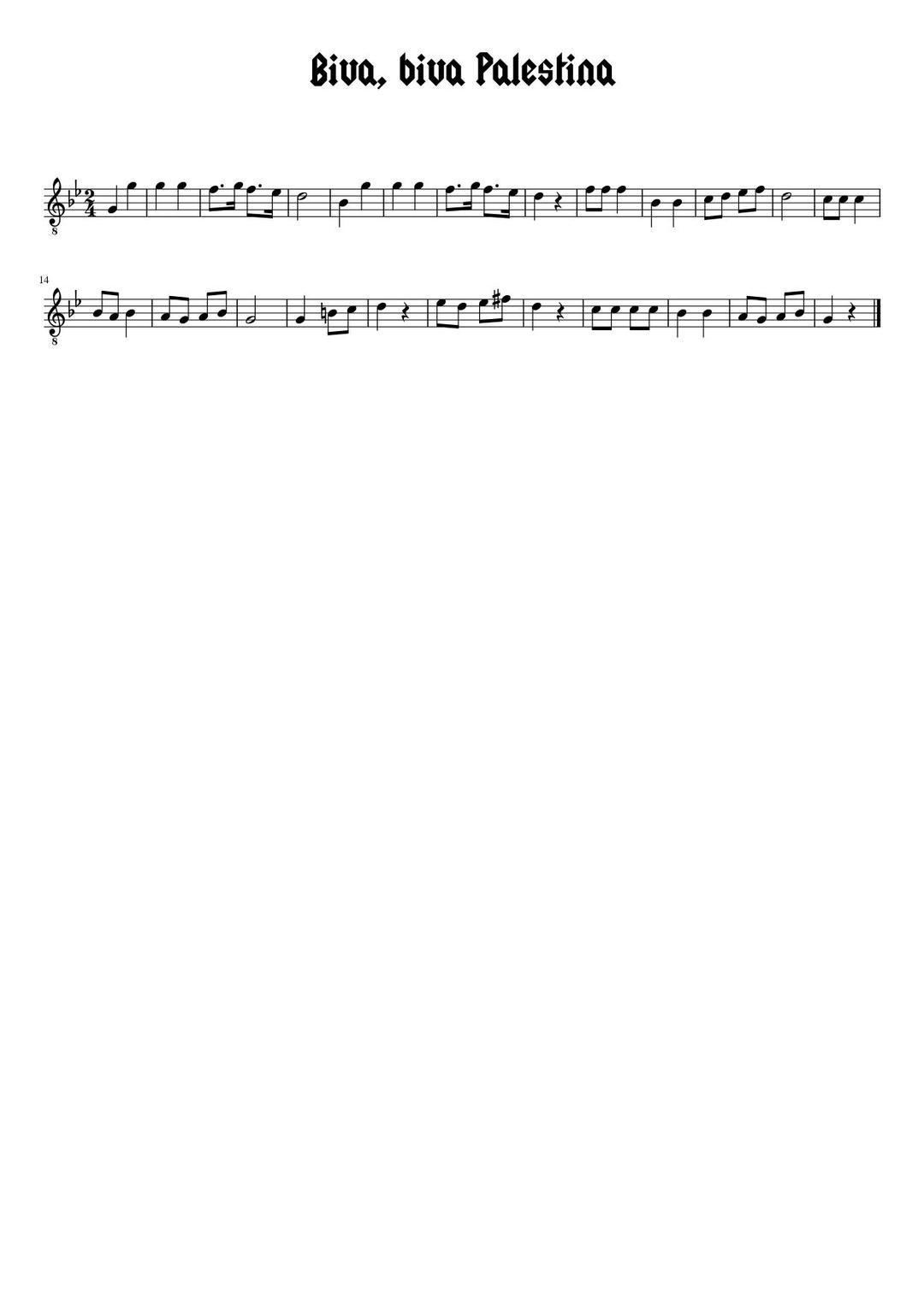
Note for the Lead sheet: In the lead sheet, the lyrics are syllabified according to Daniel Sousis’s version. However, any of the other versions may also be sung, either unchanged or in combination.
Music Guide

 Bibliography
El Trezoro de Kantes de Sefarad. El Instituto Maale Adumim para la documentación de la lengua judeo-española y su cultura, folkmasa.org.
Molho, Rena. The Jews of Thessaloniki 1856–1919, Patakis Publications. Athens, 2014
Nehama, Joseph. Dictionnaire du Judéo-Espagnol. Madrid: Consejo superior de investigaciones cientificas, 1977.
Research, analysis and translations: Mariangela Chatzistamatiou Aural Transcriptions and Lead Sheets: Nikos Panagiotides
Disclaimer: The content on this website is protected by copyright. Use of the content is allowed for personal or educational purposes only with clear citation of the source. Republishing, modifying, or using the content for commercial purposes is prohibited without prior explicit permission.

